
who we are
At GEC, our unwavering mission is to make lifesaving emergency medical care available to all. We believe that every individual in Uganda deserves essential, timely care, especially in times of acute illness and emergency. By building the capacity of emergency medical personnel and strengthening healthcare systems, we ensure that no one is left behind. Our approach is rooted in collaboration and innovation: working closely with like-minded partners to develop comprehensive training curricula and systemic solutions that eliminate unnecessary death and disability from treatable conditions.
Since its inception as an NGO in 2008, GEC has been committed to the strategic enhancement of Uganda’s emergency healthcare providers, driven by sustainability, excellence, and true partnership. Through our collaborative efforts, we work to scale the provision of life-saving emergency care. This drives our aim to set a transformative example in healthcare delivery – a commitment that brings hope and a promise of a healthier future for every Ugandan.
Vision
We envision a time when no life is limited due to an easily treatable illness or injury.
Mission
To make lifesaving medical care available to all Ugandans
Theory Of Change
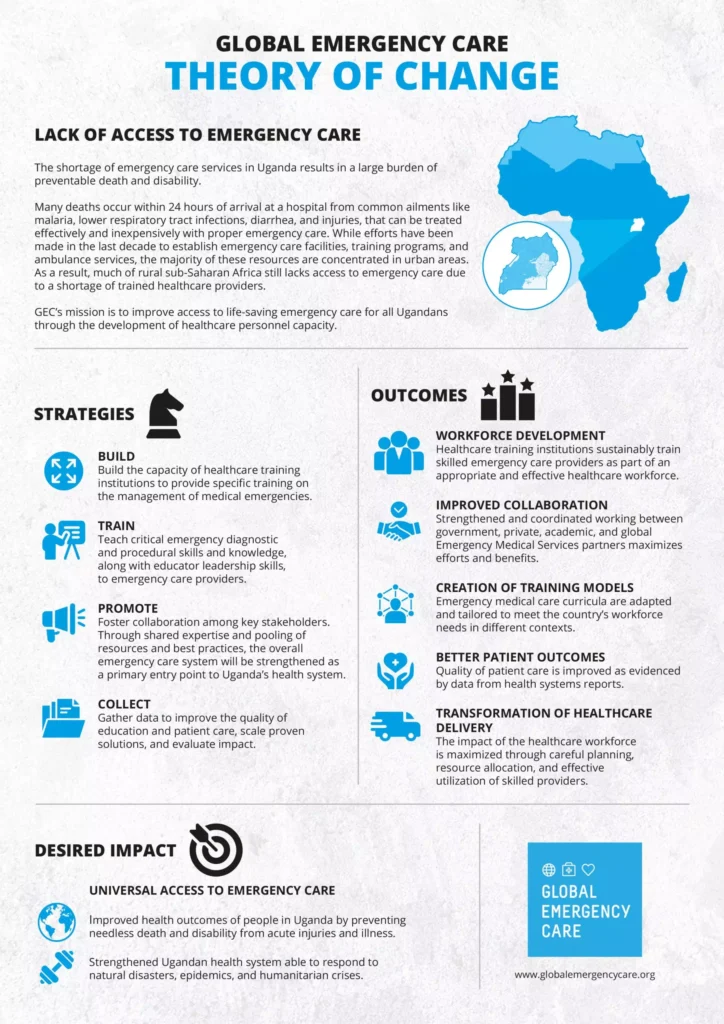
The shortage of emergency care services in Uganda results in a large burden of preventable death and disability. Many deaths occur within 24 hours of arrival at a hospital from common ailments like malaria, lower respiratory tract infections, diarrhea, and injuries, that can be treated effectively and inexpensively with proper emergency care. While efforts have been made in the last decade to establish emergency care facilities, training programs, and ambulance services, the majority of these resources are concentrated in urban areas. As a result, much of rural sub-Saharan Africa still lacks access to emergency care due to a shortage of trained healthcare providers. GEC’s mission is to improve access to life-saving emergency care for all Ugandans through the development of healthcare personnel capacity.
Strategies

BUILD
Build the capacity of healthcare training institutions to provide specific training on the management of medical emergencies.

TRAIN
Teach critical emergency diagnostic and procedural skills and knowledge, along with educator leadership skills, to emergency care providers.

PROMOTE
Foster collaboration among key stakeholders. Through shared expertise and pooling of resources and best practices, the overall emergency care system will be strengthened as a primary entry point to Uganda’s health system.

COLLECT
Gather data to improve the quality of education and patient care, scale proven solutions, and evaluate impact.

Outcomes

WORKFORCE DEVELOPMENT
Healthcare training institutions sustainably train skilled emergency care providers as part of an appropriate and effective healthcare workforce.

IMPROVED COLLABORATION
Strengthened and coordinated working between government, private, academic, and global Emergency Medical Services partners maximizes efforts and benefits.

CREATION OF TRAINING MODELS
Emergency medical care curricula are adapted and tailored to meet the country’s workforce needs in different contexts.

BETTER PATIENT OUTCOMES
Quality of patient care is improved as evidenced by data from health systems reports.
Desired Impact
Universal access to emergency care

Improved health outcomes of people living in Uganda by preventing needless death and disability from acute injuries and illnesses

strengthened Ugandan health system able to respond to natural disasters, epidemics and humanitarian crises